







Marking, memory, identity, and permanence

You’ll notice something if you start paying attention to objects.
Monograms.
Signet rings.
Initials carved into desks.
Names scratched into school tables.
Graffiti.
Love locks on bridges.
Love bites on necks.
Humans have always had a habit of marking things.
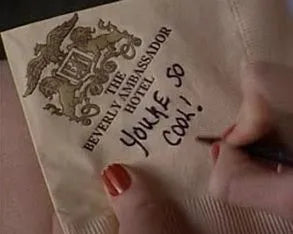
We write on them.
Scratch into them.
Etch initials.
Stamp dates.
Leave small declarations of existence.
Sometimes, if the mood catches, we’ll even bite them.
A small declaration of love.
Or passion.
A name carved into a school desk.
A monogram stitched quietly into linen.
A signet ring pressed into wax.
A fleeting bruise left where lips lingered too long.
It’s an old habit.
And if there is one thing we like, it’s an old-school habit.
Long before social media profiles and carefully curated biographies, humans had a simpler way of announcing themselves to the world:
“I woz ‘ere.”
Not loudly.
Just enough.
Archaeologists regularly uncover graffiti scratched into the walls of Pompeii.
Two thousand years later, the instinct hasn’t changed very much.
We still want objects to carry some trace of us.
A plain object is tasty all on its own.
But introduce a name, a date, a phrase that means something only to you (& them), and it begins to behave differently.
It stops being interchangeable.
It becomes specific.
Personalisation, when done well, isn’t decoration.
It’s authorship.
You’re quietly editing the object’s story.
At BAG&BONES we see this often.
A neon phrase chosen because it means something to two people and almost nobody else.

A small line etched into metal that reads perfectly ordinary to everyone except the person who asked for it.
The object itself hasn’t changed very much.
But its gravity has.
It holds a moment.
A memory.
A small piece of identity.
I’ve always had a quiet fondness for second-hand bookshops. I can never quite explain why, but whenever I drift through their shelves I find myself drawn not just to the books, but to the small inscriptions hidden inside them.
A simple line written on the first page - sometimes nothing more than “with love.”
There is something deeply romantic about it.
A small, handwritten trace that lingers long after the moment itself has passed.
It feels almost like a whisper from another time.
A quiet reminder that someone was here -
and that, for a moment, this meant something.

This is Chapter III of Objects & Emotions — a series exploring the quiet relationship between the things we keep and the feelings we attach to them.
Explore our personalised etched gifts or create custom neon signs with words that mean something to you.